Thursday, 19 February 2009

just had a *@G*!^*! moment

*******! - this was going to be a superb mnemonic...but I just realised that my sofa was misremembered. So....

For god's sake do not memorise this.


IT WAS a great inspiration. I needed a way of remembering the rest of my Dotty Dog formula. This pictorial mnemonic. Dotty dog x A-Z over sofa
where Dotty Dog is Distance off track x 60 over Distance gone
A-Z is Total Track (all the way from A-Z) Sofa is Distance gone SoFar

SOFAr is the big mistake.....because it is not so far, but distance TO GO

(I shouldn't really publish this, but seems a shame to waste the effort! Blame me when future students all get this question wrong!

I can keep the dog and the A-Z but I need to replace the sofa with a means of recalling DISTANCE TO GO. I suppose I could move the sofa and have my dotty dog sitting on it, as that part of the formula is about how far I have gone so far, but it confuses things, I reckon, and could make the DOG redundant, poor thing.....and I really love that dog!

The Plodding Plotter

Last night (the small hours of the morning actually, which is when my brain clicks into life) I worked steadily through 100 Navigation questions which I got from Pegasus Flight Training in 2001 ....and I got them all right! All of them.

But there is a catch.


It took me hours. Sure, it was great revision and not only did I do it competently, but I enjoyed enormously. But it did take me ages! Must find out today how many questions are on the real paper because I don't think I could get through 100 in an hour or even and hour and a half.

I found that I could use my whizz-wheel for conversions easily (gallons to litres, km or miles to knots, etc), that I'd forgotten how to use it for wind drift, but that I was able to plot triangles of velocities on paper for this. Grid references were easy enough to find and the whole plotting and answering questions about the route, and the 1-in-60 questions were fun (using my Dotty Dog).


I really had a ball. And if I had enough time I know I would be fine on the exam...but I am a plodding plotter...and I fear that I will run out of time on the day.

Tonight - well, probably closer to 2 a.m (must talk to Irwin about setting exam at that time, hehe) I will do a mock test that Neill has set me.


.

Monday, 16 February 2009

A pedal-powered Doodlebug?

Nomad

Only a couple of years older than me in 1985, Rupert Sweet-Escott, 23, had already been flying for ten years! I'd wasted several years in a cult, had achieved almost nothing at all, worked in a bookshop and could barely afford to make the odd balsa model of a Westland Lysander, while this chap had already been a gliding instructor and built several aircraft, including a series of Nomads, prone-piloted powered hang gliders of his own design!

That is inspiring!
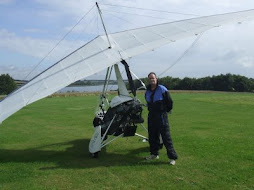
Now 47, he is producing some kind of pedal-powered hang-glider. There are few details on his site, but I have written to him and hope to know more soon. Sounds really interesting. (update - exchanged email this a.m., 17th Feb. Following two pics provided by Rupert himself)


"The mechanism is very simple:
Bevel gears to change thrust direction, a flexi shaft for the supine version and away you go"
says Ru.


Rupert just told me that he is the holder of the Welsh record for distance and duration!!!
Coincidentally, I have been reading about a pedal powered aircraft, the Musfly, that David Cook was working on in 1979, the year I took 'O' levels. Sadly, the project was abandoned, but something Cook says in the book, Flying From My Mind, really struck a chord,

"I was beginning to think that what already existed wasn't necessarily always right and often the way forward is not to be influenced by the knowledge of other people, but to believe in one's own designs"

It seems to me that Sweet-Escott has that attitude too and it really chimes with mine, and I can't wait to see what comes of it. "Ru" tells me there is even a chance that the Nomad, which had push right, go right stearing at the feet, may go back into production.

Tuesday, 10 February 2009

Snow, snow and more snow

Neill's photos make it clear why we are not flying. It is likely to take a full week for the airfield to dry out. That gives me plenty of study time. My Nav is improving and I am getting my head around Met, which is not nearly as daunting as I feared. In fact, I think I am developing a keen interest in both.

I got a couple of books from the town library, including one by Brian Cosgrove, himself and a very readable celebration of clouds, The Cloudspotter's Guide, by Gavin Pretor-Pinney. I also have a kids' Eyewitness Guide to weather, which my school's library was chucking out, which has some invaluable 3D models of weather fronts and which, co-incidentally, was also written by Brian Cosgrove, who for those not into microlighting, is the author of the microlighters' bible, the Microlight Pilot's Handbook. I have just ordered my own, second hand copies of the library books on Amazon. Both, including postage come to less that £8.

Did you know that the average
cumulus cloud holds water equal to the weight of
80 elephants!

a model of a cold front, from the ex-school book

Note to self: Design skis for Dragonfly for next winter


.

Monday, 9 February 2009

Hi Chris

Just want to say hi to Chris in Iraq!

Chris is a month away from completing a tour of duty with the U.S. Marines in Iraq and is aiming to learn to fly microlights when he gets home, and take his wife flying.

Good luck to you, mate.

Sunday, 1 February 2009

fine button operation with gloves on

Update: Since writing this entry, Stewart Bond has convinced me that watch altimeters are too inaccurate to rely on in flight, and in fact a seller on ebay revealed that they sample only every minute, so they don't give real-time readings anyway. I may well get a Digifly after all. But I like the idea of the gizmo below, even for the chance just to enjoy making it. I may make it for my stopwatch.


Have been thinking about getting an altimeter watch, but wondered how I would cope with little buttons while wearing gloves. This is one solution I think it would be easy to knock up. I would probably do it in brass, for ease of construction, but if your brazing isn't up to it, quite honestly it could be done in wood - simply drill the sleeves in a block of wood and insert loose dowels. The only real weak point would be relying on the watch button springs to pop the buttons back out, though it would be possible to put springs in the sleeves, I suppose.

Of course I don't intend to wear the watch. The idea is that it would be strapped to the base bar.


(apologies for the crude artwork, knocked up on Paint)

Wingsuits

A friend just sent me this, wondering if it might be a hoax. What I have seen (first few seconds of it), it isn't. These guys are really flying....not just falling, but actually controlling their descent...then pulling parachutes at the last second. Amazing stuff!

BASE = bridge, antennae, spans, Earth...the 4 types of high places you need to have jumped from with a parachute in order to qualify as one of the elite free-fallers. It is an extreme sport which captured my imagination about ten years ago when I read a book by a guy called Simon Jenkins, who described the anarchic business of circumventing security systems to get to the top of places that are great to jump off.

You need to be a pretty experienced parachutist to do this because you have to pull your own rip-cod from very low down and be able to judge it in extreme conditions. I bet that many who have died did so because they simply got distracted by the "rush" and opened too low. But there is nobody to stop someone trying BASE if you are not a parachutist; after all BASE is about breaking the rules and living to tell the tale.