Yesterday I heard of another big end bearing going on a Dragonfly, which makes three (including mine - and I didn't know about the one before mine when I purchased my Dragonfly, so there could easily be others).
I had been telling the pilots at Chatteris about the kicking my confidence took in my first year of being licenced when I had six engine failures in the Dragonfly, the last of which was never diagnosed by Paul Bailey, who ended up just replacing all the ancillaries on the engine. Its new owner gets lots of joy out of it, but he ought to, he has practically a new engine.
For all that the Dragonfly could be a wonderful fly, I will never be able to forgive the Bailey engine for really shaking my confidence and for having put my girlfriend off flying microlights altogether.
Thursday, 7 March 2013

Flying a C42 with Katie Denham
 |
| Not the school C42, but one Katie has a share in. |
Katie has a very calm, confident but unassuming manner and I was immediately at my ease, and almost from the off, "You have control".....and I was taxiing to runway 06. This, as you will know, is the first mental conversion required of a flexwing pilot, as the controls are reversed. Steering a trike is like steering a children's tricycle; it is direct. But a 3 axis tricycle nose wheel control is connected to the rudder, so you push right to go right. So I did it rather too slowly at first and I think Katie thought we'd never get to the runway, so took back control for a short while, then gave it back for the last 25 metres. On the taxi back I was much more confident. The trick to getting it straight is to put yourself in the centre and steer yourself rather than the nose of the aircraft, and that came naturally to me; and actually, push right, go right makes real sense. Get the throttle settings right, and I will crack it.
Once airborne the first thing I realised very quickly was how light the controls are compared to flexwing, where you are correcting all the time, and dealing with often quite strong upper body movements; so much so, that Lizzie's instructor did wonder how easily she'd manage it (though, in fact, she was a natural). Katie told me to hold the stick with thumb and fingers either side of it, rather than wrapping fingers round it, as I did at first. Your hand sort of brackets the stick, a bit like a tuning fork with the stick between the prongs. This will mean greater sensitivity, but presumably is also to stop you nervously flying nose high and stalling.
We did Ex4....controls familiarisation. I learnt about setting flaps...about the ballooning effect and how to counter it, bringing the nose down to the right attitude.The reverse, taking off flaps, was trickier because I did not realise quite how snappy the spring would be, so let the handle forward, releasing the loads, far too dramatically. But with a few tries that improved. Of course we don't have flaps on trikes, so this was all new.
I learnt a lot about setting the trim, about the nose attitude of the aeroplane, and spent lots of time looking at the airspeed indicator and the revs. The C42 trim settings are done with switches on the top of the stick, which incidentally is centrally mounted and shared. Stick forward -front button, stick back -back button. All very logical really. Trim is almost inconsequential on the Quantum, so it is some time since I thought about it, but setting it up on the C42 was just the same as doing it on the GT450. Lovely being able to do it with tiny switch inputs on the stick rather than a great big knob on the side of the A-frame.
All climbing and descending was much as you'd expect in any aircraft, PAT and APT, etc. I was pleased to be able to go straight into that without embarrassing myself.
One thing that did surprise me was that almost nothing was done with the rudder* (see update below for clarification), and not just because I was being introduced to it slowly, either. All turning was done with the stick, using the aircraft's differential ailerons. This made the operation very much simpler than flying the Tiger Moth, for instance. Katie demonstrated the way the nose can drop down to the right on a turn and how to counter it- but it didn't seem a great problem.
I loved the challenge and focus of the hour, which passed very quickly; And despite it rushing past, I felt that we covered an awful lot. I really enjoyed being a student, but like being a post-grad again I had the advantage of knowing all the basics already, so that progress was fairly rapid, leaving me feeling confident about doing a conversion, which really does have to be the next thing. Of course, lots of that confidence has to be down to Katie, whose delivery is very clear and reassuring. I did ask her how long she thought conversion would take, and she was professionally reticent to give a number, but my impression is that it is probably a very affordable 10-12 hours.
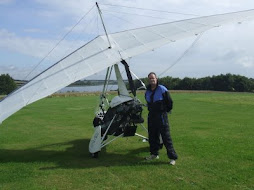
(This was a lesson, not a joy ride, so I didn't take my camera up, and the aeroplane was back in the air after my lesson before I thought to take any pictures, so I took pics of the one Katie has a share in)
..........................................
*Update
Katie has now read what I put and has got back to me with some feedback, which she has said I may quote:
"I can see that I didn't emphasise the use of rudder clearly,
it is important in the C-42 but use of it is much more subtle than in the AX
series where you need a bootful of rudder just to get the thing to turn.
However, most flex wing pilots soon get used to the rudder. The two things that
seem to be the biggest issues are learning to fly by power and attitude rather
than feeling airspeed directly and being too heavy handed on the controls;
flying with a light touch is vital, especially when landing a 3 axis as you
will be able to feel the aircraft slowing down during the hold off and feed in
more and more back pressure. A vice-like grip makes this almost impossible, but
I don't think you will have a problem with that.
There is so much to learn with 3 axis, I think it's more of an art than flex wing flying, converting is just the beginning...."
There is so much to learn with 3 axis, I think it's more of an art than flex wing flying, converting is just the beginning...."
Monday, 18 February 2013
Yakkity Yak, Yakkity Yak!
I forgot to mention that over Fram we were buzzed, ten o'clock high, by an all-silver Yak (3M, I think) with a red star on the fuselage, which turned and came past again. You can see why I thought it was a Spit at first...until it banked and I saw its wing shape, which looked oddly like a Hurricane's. We then thought the fuselage, with that wing, made it a Mustang, which would have been much more exciting than a Yak, of course, but it was still a real highlight sharing airspace with this character.

Just found this on Google and it looks like the very one. It was seen at Duxford last year in the Flying Legends show, so there is every chance it is the one we saw.
Sunday, 17 February 2013
Took Dave Flying
 |
| Dave and I teach at the same school. He is Head of Science. |

I did a check flight before taking Dave up and that circuit on its own was glorious.
click images for clarity
b.jpg)
.JPG)
b.jpg)
b.jpg)
We hovered over some very grand houses
c.jpg)
Altogether a superb day's flying!
Monday, 11 February 2013
my diversionary track
I have been looking at satellite images of the area around the airfield to try to work out where I flew when I couldn't pick out the mast because of low cloud and haze. I didn't want to fly straight towards the mast from Debenham in case I didn't spot it soon enough to avert disaster, so I diverted to the right and tried to pick it up on my left. This course took me north of the field, but it was tricky orientating myself.

 I spotted the smaller tower (the Repeater Station at Brockford) and used it as a way point, turning back on myself and trying to rotate the shadow of the former aerodrome below me, until I spotted the hangar and the runway off to my right. But it was the tower at Brockford which got me back on track.


click images to increase size
 I spotted the smaller tower (the Repeater Station at Brockford) and used it as a way point, turning back on myself and trying to rotate the shadow of the former aerodrome below me, until I spotted the hangar and the runway off to my right. But it was the tower at Brockford which got me back on track.
Quite frightening how close you can be to home before you pick up familiar references, though.
Sunday, 10 February 2013
Finally! Flew again after two months grounded by weather
It wasn't for long, but yesterday I finally got back in the air and I feel fantastic for having done so. I was really pleased by how easily the engine started and relieved to find that the ground, though sodden, was firm enough to taxi on and the main runway firm enough to land on safely.

The only real negative was the cloud base, which forced me down below a thousand feet (especially on the return leg) and much of the time from Framlingham I couldn't see the mast; in fact I couldn't even see Debenham much of the way, picking my way along 269 degrees, just trusting that I'd hit the town eventually, which I did, of course. But it is disconcerting being two and a half minutes from home, flying beneath the Wattisham panhandle, so around 800', and still not being able to see a mast which is two hundred feet taller!! But eventually it emerged and I found that I was slightly too far north of it (and alarmingly too close to the smaller mast just by the A140), which meant that I then made a very conspicuous cross wind approach; the hang gliders on the ground will have seen me for longer, and waited for me before launching.
I am so glad that I was free yesterday on the first flyable day in ages, with snow forecast for the week ahead.
I am glad that I seized the day.
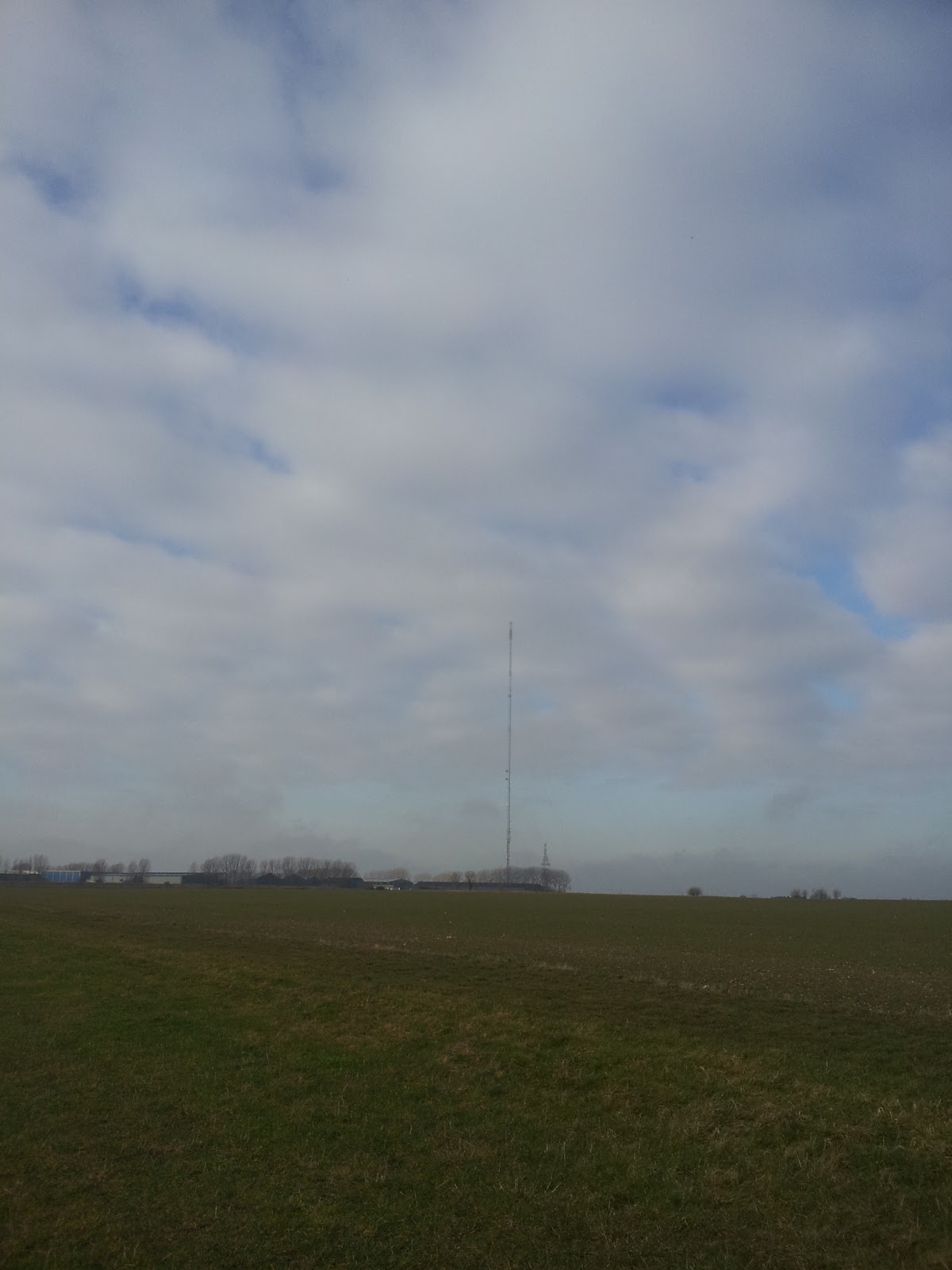
The only real negative was the cloud base, which forced me down below a thousand feet (especially on the return leg) and much of the time from Framlingham I couldn't see the mast; in fact I couldn't even see Debenham much of the way, picking my way along 269 degrees, just trusting that I'd hit the town eventually, which I did, of course. But it is disconcerting being two and a half minutes from home, flying beneath the Wattisham panhandle, so around 800', and still not being able to see a mast which is two hundred feet taller!! But eventually it emerged and I found that I was slightly too far north of it (and alarmingly too close to the smaller mast just by the A140), which meant that I then made a very conspicuous cross wind approach; the hang gliders on the ground will have seen me for longer, and waited for me before launching.
I am so glad that I was free yesterday on the first flyable day in ages, with snow forecast for the week ahead.
I am glad that I seized the day.
Sunday, 11 November 2012
Hi Piotr

My nav is getting better. Today I flew this plan and completed it with an error of only 45 seconds! It was a triangle from Mendlesham to Bawdsey on the coast, past Woodbridge aerodrome and Bentwaters to Framlingham, then back to base via Debenham. The air was very smooth indeed, except near the ground. I had an irritating niggle along the way with my glasses which rode up under my visor; going to have to find a way to secure them better.
A highlight of the day was taking Piotr (Peter) up. He came to the airfield on spec, having read about it on a forum. He wants to fly and is going to start off on hang gliders. Piotr is Polish and has been here, with his wife, for four years.
Piotr borrowed a suit and helmet from a hang glider pilot, as I didn't have any spare kit with me, and unfortunately that meant we had no comms, apart from thumbs-up. We flew around Fram castle at about 700' and enjoyed turbines and the old windmill en route. A really spectacular introduction to England from the air.
Piotr borrowed a suit and helmet from a hang glider pilot, as I didn't have any spare kit with me, and unfortunately that meant we had no comms, apart from thumbs-up. We flew around Fram castle at about 700' and enjoyed turbines and the old windmill en route. A really spectacular introduction to England from the air.
 |
| Piotr |
Piotr, it was good to meet you. See you again at the airfield.
It was great to be back in the air after an awful summer, which included a foot infection which put me on crutches, several head colds, diabolical weather and a need to change the front wheel's innertube, as it had been creeping on landing, so that the valve was being drawn into the wheel and becoming very hard to reach with a pump.

I replaced it with an angled valve, like the ones on the back, hoping it would clear the trailing link, but sadly it didn't and I had to change the tube yet again. Never mind, at least it is another job that I now know I can do on the plane, myself. Incidentally, taking the tyre off with levers wasn't too tricky, but putting it back on was a bugger and not worth the effort. Orwell Motorcycles in Ipswich did it both times for no charge.
It was great to be back in the air after an awful summer, which included a foot infection which put me on crutches, several head colds, diabolical weather and a need to change the front wheel's innertube, as it had been creeping on landing, so that the valve was being drawn into the wheel and becoming very hard to reach with a pump.

I replaced it with an angled valve, like the ones on the back, hoping it would clear the trailing link, but sadly it didn't and I had to change the tube yet again. Never mind, at least it is another job that I now know I can do on the plane, myself. Incidentally, taking the tyre off with levers wasn't too tricky, but putting it back on was a bugger and not worth the effort. Orwell Motorcycles in Ipswich did it both times for no charge.
Subscribe to:
Comments (Atom)





.JPG)
.JPG)


.JPG)