Thursday, 29 October 2009

rigging and de-rigging solo

I have no pics of the flying itself (must do something about that in future) but it was glorious (why do the most expressive adjectives sound so old fashioned?)

While I was unloading, Steve crept up behind me in his Dragonfly. I was amazed that, whether because I was just too involved in getting organised or was up wind of him (noise, not smell, lol), I didn't hear him taxying, let alone land.

Steve Wilson in G-IWIZ

My wing outrigger (for loading and unloading solo) works brilliantly. I did most of my rigging myself, insisting that Steve didn't make it easy for me (though I did ask him to do a few battens, just to speed things up); and once we had landed after our "sector recce" and said our goodbyes, I was de-rigging solo for the first time and very much aware that nobody was going to bail me out if it went wrong. So I was delighted that I packed my wing away very tidily indeed.....and got it up on to the van roof-rack with ease.

de-rigging with nobody to bail me out if I got into trouble

ready to load up van

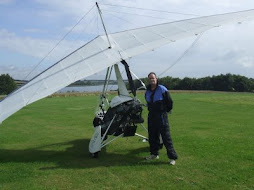
I took lots of pictures of the trike and of the narrow gauge undercarriage. The day before I'd made a gizmo for keeping the ramps parallel too, and was pleased that it seemed to work ok.


the trike before the narrow gauge wheels are put on


Both sets together, before the wider set is retracted for transit


lifting narrow gauge wheels onto trolley raises undercarriage off ground


retract main gear


dispense with trolley

load up.
(the narrow gauge wheels fit the trike in the van and will run it through my front door, where the trolley makes it manoeuvrable -sideways etc- indoors, where space is restricted)


Sunday, 25 October 2009

Repairs done

Yesterday I made parallel spacers for my ramps, so that I don't have to keep tweaking them when running the trike up and down them, recharged the battery and refitted it (though my local motor parts specialist had never even heard of locking wire!), re-stuck the plastic inside the monopole splint and cleaned up the holes on the monopole and splint so that the two bolts slide in more easily. I guess I am ready to test everything.

But I have been looking at the weather and the wind is up. I reckon Tuesday looks best for a test flight.

Saturday, 24 October 2009

varifocals

Other exciting news is that I now have varifocal glasses, making it possible to see both at a distance (I am short sighted) and read a map on my lap. Young eyes are able to change shape enabling them to adjust for both short and long distance, but in your mid forties, typically, the eye hardens and makes this adjustment difficult, so that while I have used the same prescription for ten years for reading as for driving (and everything else), recently I have noticed that it has been easier to take my specs off for reading....and that has made it very difficult indeed to read a map while flying. Hopefully varifocals will make both possible.

For anyone unfamiliar with these things, you look through the middle and upper parts of the lense to see middle and long distance, and through the lower part of the lens for reading. Getting used to them typically takes a couple of weeks, but luckily my prescription isn't too bad, so I am already getting used to them.

For flying on bright days I also have varifocal shades which look very cool indeed...with head hugger stems, making it easy to slip them under a helmet or headphones.

Starting a Bailey engine after it has stood for some time

Ben wrote back to my worried enquiry about my starting problems, and his advice was very helpful indeed. I followed it up with a call about charging my battery and that too very much reassured me. He is very clear that when in doubt, he is happy for people to ask.

I hope he won't mind me quoting him, because I think this could help others:

"Starting the engine after leaving the engine for a few weeks:

1) No throttle, throttle closed.
2) Turn engine over and keep it turning to pump up the fuel. This may take up to a minute if the fuel bowl in the carburettor is empty. Once the fuel bowl fills the engine will fire.
3) If the engine does not start after turning over for up to a minute. Leave alone for at least 2 - 3 minutes, the generated vacuum in the crank case and fuel system will draw up the fuel. Now try to start and she should fire almost immediately.
4) Do not use any throttle until the engine fires, the automatic choke is on full at this point and any throttle will simply flood the engine and prevent firing.
5) If engine fires and stops, open the throttle by a small amount (10%) and she will fire.

Pissing in the wind is better than 5 second bursts, the initial rotation of the engine requires huge power from the battery and repeating this will flatten the battery very quickly, make sure the battery is fully charged before starting, charge at home if you haven't been running the engine for a long time.

Try to start the engine and run it for a minute or two every couple of weeks, this will keep the fuel line and fuel bowl primed and help start the engine first swing. "

It all makes perfect sense. Short bursts just drain the battery. Ben said that the initial load on the battery is actually, for a microsecond, greater than the fuse rate, but it is so short a burst that the fuse doesn't blow....but if the process is repeated over and over, it is bound to deplete the battery, especially as it hadn't been charged after standing for a few months.

So, this afternoon I need to snip my securing wires on my battery connectors and get that battery on charge while I find someone local who sells locking wire. I reckon I will get loaded up to fly tomorrow, when hopefully the weather will be better.

Thank you, Ben

I have just heard back from Cath at Flylight, too, confirming my payment for a front strut protector; they now have them in red :) again, and for an F1 funnel, which is the type she uses on her Dragonfly and which she says fits the Dragonfly well. The great thing about these funnels is that they are designed to filter out water caused by condensation in fuel tanks.

Thanks Cath.

Sunday, 18 October 2009

Frustration

Compass pillar slots neatly into the hole-saw cut hole in the binnacle and is secured with velcro. This places the compass low so that the rear digits can be read easily and, unlike other solutions I have seen, cannot be bumped by the speed bar.


The outrigger bar performed well today, enabling me to load the wing single-handed at the airfield, though Steve did help me get it to the car, which I think might be easier if I made a skid or golf-trolley type affair.

Much of Saturday was spent getting last bits and pieces ready for today, which was to have seen my first flight from my home field since I qualified. I finished my outrigger for wing loading, cut a hole in my binnacle to mount my compass, tweaked my roof-rack, put pipe lagging on the rungs of the ladder and made a monopole support (for transit), which secures in place with velcro.....

and felt ready.

Loading up today (including erecting the roof rack), took over an hour, though I was grateful for a hand from my neighbour, David, in lifting my wing on to the roof of the van. I had an uneventful trip to Rougham, where the gate was opened by an aeromodeller and where another told me my mate was waiting and asked if I'd call up on Rougham Radio to let them know when I was taking off, so that they could ground their models first.

I met Steve and then discovered that he had turned out, just home from a trip, not intending to fly, himself. I'd imagined that he was going to be rigging his Dragonfly too. Very generously, he came just to help me, though he would also say that it gave him the chance to try out a half-tension rigging, which we concluded was not really easier and which created its own problems; we had to de-batten 8 and 9 to release sufficient tension to be able to locate cam cups over the wands; I found camming-over a lot easier today, both on half tension and no-tension; and tensioning at the keel (in both modes) was a lot easier today, too, which bodes well for the future.

But lifting the wing so that the monopole located was murder and Steve is adamant that it is a process which is best suited to hangar rigging. He watched and was very unhappy with the twisting that he observed in the plates either side of the monopole. Eventually we got it rigged, but only after a bit of surgery on the plastic sandwich, which had become rucked in the process. This is a bit worrying for me....

...but not as much so as the fact that I couldn't get the engine to start. The simple fact is, we later discovered, the filter was dry. I tried and tried to start until my battery was out of juice. I am guessing this is down to that fuel pump problem which Ben designed the modification to deal with. I have never encountered a problem with mine, but before I try anything else, I shall do the mod (and recharge the battery) and try to start it again.

This is the second week in a row that my plans to fly have been frustrated. Last week my van failed its MOT, now sorted. This week engine problems.

Damn.

Huge thanks to Steve for turning out and sticking with me through it all. Ah well, I expect I have learned quite a lot anyway and my rigging times are bound to be improving. Tell you what though, I can see why Steve has dispensed with body panels. I think life would be a lot easier without them. For pragmatic reasons, I reckon I will leave them at home next week.

Sunday, 11 October 2009

a wheelchair ramp provides a compact, lightweight solution

I didn't like my ladder-based ramp. It was heavy, clumsy...and got me teased relentlessly at Sywell ;)

So I decided to either make, have made or buy something more compact . . . and found this on ebay: a portable wheelchair ramp, capable of carrying 28 stone...and designed to be carried by taxis, etc. I have played with it, but as my van is currently at the garage, I haven't had the chance to actually try the ramp out properly.

It is a nice little design made from aluminium extrusion, which telescopes in three stages from 28" to 5' (which is a bit shorter than my own ramp, but which I think will be fine) and has a grippy, sandpaper-like running surface. It comes in its own, conveniently designed zip-up canvas bag, compact enough to put in the seat-well too; better than having to go to the trouble of securing a ramp to the roof-rack and having to check the straps at every service station.


£44 including postage.


.

Monday, 5 October 2009

red check


The mobile tower at Rougham is provided in the form of a truck (with a collapsing chassis) known affectionately as the "ice-cream van", but carries a stern warning not to ask for ice-cream. Spot the clue that it was not kept busy on the 3rd, when it was blowing a gale outside.


In by-gone years, this caravan (below) did the same job at another airfield before being purchased by Rougham's owner, Sir John Agnew, who I haven't met yet, but who is very much a man of the people and a great aviation enthusiast. It is down to his attitude to flying that I am allowed to fly at Rougham.


This weekend it doubled as a hangar for Felix's model aeroplane. It is rather cosy, with a bunk on one side, storage space, a hatch at the top of a ladder and a swivel chair poking up into a cloche-style tower, about as roomy as the cockpit of a Messerschmitt 109


I clambered up into it and saw that albeit cramped, it gave a good view of the field and I think it would be great if it was used more. It is a beautiful bit of kit.