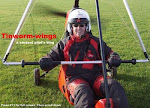
Trying to work out how to copy this commercially produced dvd of my Tiger Moth flight, so that it can be viewed on here (probably not meant to do it), so for now here is a very nice still. Yes, that is me in the front seat.
Sometimes I go trawling the net looking for anything on Dragonflying, which makes me wish that other Dragonflyers had blogs so that I could find out what you are all doing.
It is very easy and need take no longer than ten minutes after a flight or day at the airfield.
I went to Sutton Meadows today in the hope of flying, but doing so was frustrated by necessary fettling and by wind (not mine).
The "slight second" front strut's bushes were too tight for pinning so needed easing out, for which I had to use a screwdriver and the thread of a bolt...in the absence of a reemer or file...and eventually they fit well enough to rig....but I need to finish them off at home.
I tried out my quick release boss, which I like a lot.
I have the trike all together now and have added in to the back of the seat some of the wiring for my auxilliary socket. Incidentally, I learned from Ben a few days ago that I have two spare wires (spades) in the loom for just this sort of thing....so won't wire straight to the battery.
I heard Ben use the term fettling, so used it today. I just looked it up and it has various meanings, but is derived from the metallurgical industries and is to do with lining the furnace with sand and ore before pouring molten metal. It can also mean knocking the excess metal (sprue etc) off a cast component and has come to mean fixing or repairing; and cleaning something up or putting a finishing touch on something.
So, especially when cleaning out those bushes on the front strut, but in prepping my trike, generally, I really was fettling this evening.
A highlight of the weekend was meeting John Elliot, the only licenced Gyroplane display pilot in the UK, when I was a glorified parking attendant at Rougham - marshalling aircraft myself for the first time.
He put on a really super display of autogyro flying . We had a chat and it turns out, unsurprisingly, that he knows Ken Wallace, our mutual hero.Helping out with the BBQ at Sutton Meadows last night I talked to another John, a microlight pilot who did a 30 hour conversion on to gyroplanes and who raves about it.
You can see from the shadow that this trike is about to touch down near the 200 line (an arbitrary score line, not a measurement)
It was incredibly frustrating being sans Dragonfly this weekend, especially when I was marshalling the spot landing event, when I should have been flying it! You stop your engine or set to idle at 1000' and descend in the circuit to land (as with an engine failure and as per Colibri rules) and to keep those points you need to stop before a given point. Few did better than 50.
One newbie impressed me by having a second go just for practice, after failing to land and having to go round. On his second attempt he scored and braked on time. I was inspired; I reckon the Dragonfly could be made to score at 250 and brake at 50!
Apparently the club's own fun competitions days no longer happen, through lack of interest. I think I will have to drum some up because I can't wait until next year to have some fun like this.
When Steve Wilson (fellow Dragonflyer) was telling me, on Saturday, about our mutual friend, Philip Bendall, getting a Dragonfly, I said that we ought to start a flying circus.
Nobody get alarmed, now. Any landing you walk away from is a good one....even when you plough into a field of crop when your engine fails on take-off, as it did on Monday. The only thing I hurt was my bank balance, and even then it could have been a lot worse. The take-off was longer than I'd have expected but I put this down to slow wind. The climb was sluggish, so that I checked that I had the throttle all the way out, which I did...but the Dragonfly levelled off at about 100', if that (my vario had chosen this time to fail too!), then started sinking startlingly quickly, so that when I started a quick turn to do a downwind landing onto the field, I wasn't sure I'd pull it off, so straightened up again. But then I was running out of surface. At the end of the field beyond the runway is a deep ditch and if I struck the far bank I would probably break my neck. I couldn't stop short of it and it didn't look like I could flare over it, so I made a very fast decision which makes me proud. Counter-intuitively, I pulled the bar in, increasing my rate of descent, but also raising my speed, creating lift over the wing, so that we leapt the ditch and just made it into the crop beyond. The crop was thigh-high, so there was no chance of rolling to a halt - the crop acted like an arrester wire; the front wheel hit in hard and the plane slewed sideways, so that the front strut bent dramatically and the trike turned up - its starboard wheel in the air...and I hung from my strap and struggled to release myself, before calling in on the radio that I was ok, seeing Dave Broom's Quik circling above. Baz called me on the mobile - he had seen it all - and assured me that Dave Garrison, who had also seen it from his window, had jumped in a truck and was on his way. Shortly afterwards, he and another pilot arrived to help. Embarrassingly, this is not the first time Dave has rescued me!But as last time, it wasn't my fault - neither bad airmanship nor poor judgement before flight had caused the engine failure. I got home last night after three days away from home - filthy and exhausted, having camped at Sutton Meadows and at Sywell and after two days of exertion. Tuesday and Wednesday I was up at Sywell, where Paul Dewhurst let me do my own mechanics, sympathetic to the fact that as I am out of work, I really can't afford expensive work on things I CAN do myself; when Ben gets back from France he will do the bits it will need an expert for. (He will put bushes in my widened monopole holes, etc).I took the engine off the trike (with help and advice from Mark) and put it in my van ready to take it down to Paul Bailey. Then I changed the front forks. But the best bit, the part that makes me feel proud of myself, is that I taught myself to take the sail off, which I did while Stew was gliding Tuesday evening. And he confirmed when he got down that the tubes had sustained no damage. He agreed that only the splayed hang bracket will need replacing.I struggled quite a bit getting the sail back on, punctuated by occasional teasing from Stew (one time champion hang glider and now-instructor), but eventually succeeded after camping beside it, then finishing at about 5a.m., as balloonists inflated their ballon nearby.
I talked to Paul Bailey at lunchtime today and he put the engine failure down to the big end bearing, which he has replaced for free with a more robust one which he uses in his more recently developed engines. I did ask that if the repair didn't cost me a lot, he also fit the quick release hub which is also a recent-ish development and which I have coveted for some time; so now I have one of those too. So, it won't be a cheap crash, but I think my plane will actually be better than before it happened.
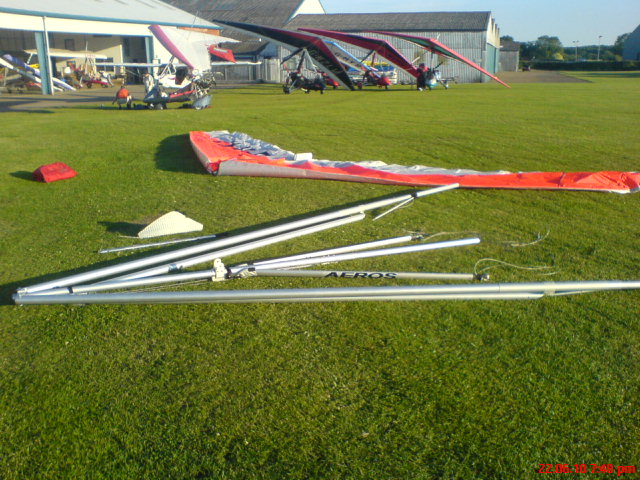
I went back to Sutton Meadows with the wing and re-rigged it and put it back in the hangar with Andy (a really nice hang glider pilot who told me about ground handling), then talked to Roger, a glider tug plane pilot, who is an interesting personality. It was gratifying to have my wing safely back on its trolley in its bay before coming home. (there was another pic and more text but the editor kept messing about with its html, so I give up - below is a pic of the wing skeleton)
They have added stats here and it is amazing to see how many hundreds of people have visited this site. My partner teases me that nobody reads this thing. Please, if you follow this blog, would you click to add yourself as a Follower. It has always been very encouraging to hear from people I meet that they actually already know me from my blog.
Also, please put comments below articles. Feedback is very much appreciated.
starting from 19th November 2010
tinworm63@gmail.com
Neill Howarth photos of me in my Dragonfly
click image for slideshow
Wing Commander Tinworm
Sadly, this is a complete fantasy. I got the uniform on ebay for a hangar dance at Biggleswade. My girlfriend at the time made a dress from a pattern we found in the States. We had our pictures taken in front of various aircraft, dined with a flight sergeant and his wife (in that uniform, I rather expected him to salute me) and we jived the night away! It really was a "splendid" night.
I flew a Chipmunk
Click to read all about it.
A Fabulous Flare
Click pic to read all about it
early in my training, standing behind a GT450, which I had just landed at Pitsford
or you can just read your drift off a ready-reckoner
click image for article
Neill Howarth
click pic to read my instructor's pearls of wisdom :)
films of the Dragonfly
Before it became the Dragonfly, the people at Flylight played with lots of possible names, including the clever Lightfly. Here is an early concept film showing an unfaired prototype. Great stuff.
Here's a great film about how to assemble the Dragonfly. My actual Dragonfly: G-CFKK is the one shown in the film. Mind you, I keep my trike assembled, with the wing off and stored in a wing bag, which I carry on the roofrack, with the trike in the back of my van (on its narrow gauge undercarriage).
A masterpiece from the prolific editing suite of Ben Ashman isElectric Blue, filmed one frosty day at Pitsford, which was where I did my first solo out-landing - in January 2009. I was the first person in the year to log-in. The film features a clip at the start demonstrating the electric undercarriage retraction. The red Dragonfly is mine. It has manual undercarriage, which deploys and retracts more quickly.
French pilots are so stylish! Here is a superb film featuring many times world champion microlight (ULM) pilot, Samir Elari, flying and discussing the Dragonfly.
Ground handling (how to store an aeroplane at home and get it to the airfield)
Follow these links to look at my system for manoeuvring my trike through my front door and into a van without taking the panels off and folding it up....and my chock trolley for easy movement in the front room-cum-hangar.
A trial flight in a Thruster, when I was 28, c.1991
I have started to learn to fly before...TWICE! First time round I had just graduated and got a job at an aerodrome in Cornwall, where I earned flying hours by fuelling microlights, giving hourly weather reports to the Met office etc. The weather was bad, so there was little flying to be had...and in the end I was paid with broken propellers and bits of crashed fuselage to hang on the wall. The boss was a great bloke called Ian Stokes, who had been a leading light in forming the BMAA and had manufactured Thrusters in the early days . In retirement he moved to The Gambia and became a publican and, shockingly, was murdered this year.
Flying Rogues
ten years on from my first experiences at Moorland Flying School (and now nearly ten years ago) the flying school was under new management and my girlfriend and I booked full courses. We both made good progress initially but never felt we were being moved on and had difficulty pinning the instructor down to signing our logbooks. When another instructor signed himself as P1, we got suspicious, contacted the CAA and were horrified to learn that our instructor did not have a current instructor rating, that we had not been insured and that none of our hours counted towards our licences. We were eventually refunded and the instructors were prosecuted by the CAA.
The very sympathetic CAA investigator spoke to the BMAA on our behalf and my hours have been allowed to count (at the discretion of the school). But in point of fact, I flew way over the minimum number of hours subsequently, so it is really quite academic in the end.
Around 2001 an instructor in Norfolk tried to convince me that if I bought his aeroplane he could teach me at a cut rate, as I'd then be using my own plane. Great idea, I thought, except that it turned out that the aircraft in question had failed a noise test and could not be used from the instructor's field. He later admitted that I would have to learn on his aeroplane at the normal rate. He resisted showing me the paperwork, kept avoiding me and eventually, when it was quite clear I wasn't going to buy without the paperwork, told me to F-off.
So far my experience has been that there are a lot of rogues in flying, which is one reason why I was so very impressed by the professional set-up at Sywell.
BOAC VC-10 to Africa
by air to Africa
My sister and I were lucky to fly many thousands of miles in the 1960s and '70s in many aircraft types, including BOAC VC-10s, Boeing 707s and even a Nigerian Airways Dakota, as our dad (and later our mum) had teaching posts in Kenya and Nigeria. Those were still the romantic days of flying, when passengers walked across tarmac and up steps, rather than walking down the tubes that have turned passenger flying into a mundane affair. (Mind you, aren't take-offs still incredibly exciting!?)
Back then air hostesses GAVE children the sorts of nick-nacks that their parents have to pay fortunes for from the airline catalogue these days; things like model aeroplanes, keyrings etc. We were also given sweets to help us cope with depressurisation. (And they were hostesses, so nobody give me a hard time)
Mum says that I cracked my first joke when I was small, on a flight out to Kenya, when I said, "Mummy, shouldn't there be a wing on this side of the plane too". Apparently I got her with that one.
At Kano airport I remember standing behind an engine and thinking how hot it still was....and then being told that the engine was cold. The heat was Kano. I got a headache and took several days to aclimatise.
The airport perri-ways at Kano were littered with aircraft that didn't make it, including a burnt-out Mig 15. The Nigerian Airforce flew them and my dad played squash with one of their pilots, Ben, at the Kano Club. I recall a Mig fly-past on my birthday. Was it arranged with Ben over a beer? Was it a pure coincidence?
At Entebbe airport (Uganda) I remember climbing down the steps on to the runway and being encircled by soldiers with machine guns, who then went through all our belongings and confiscated my cherished Swiss Army penknife, purchased on one of numerous European stop-overs. That was in the twitchy time after the Israeli hijacking ...and mum had to stifle my protests.
Before my first flight to Nairobi, as an infant, I was scared stiff. I didn't understand that I wouldn't have to sit astride the fuselage, as I did on my pedalcar! In a funny way, I not only overcame that fear but have come full circle; microlighting is just like sitting on that pedalcar......open to the elements - real flying!
Raoul Hafner dissertation
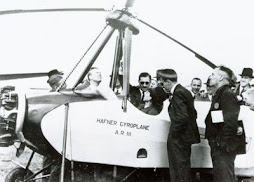
"The elegant solution: the work of Raoul Hafner, pioneer helicopter designer" was the topic of my BA(hons) dissertation. I had met an old lady in a bookshop who saw me showing interest in the aviation section and introduced herself as the widow of Raoul Hafner, who she said had invented the helicopter before the design was ripped off by Igor Sikorski. As it happens, it hadn't been and Hafner himself had never made such a claim, but he did get his first helicopter, the Revoplane 1, airborne in Austria before Sikorski's first helicopter flew. The picture above is not the R1 but an autogyro, the ARIII, which was actually more revolutionary than Cierva's, as it incorporated tie-rods and cyclic and collective pitch control.
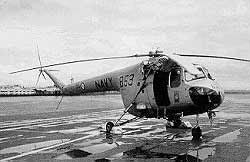
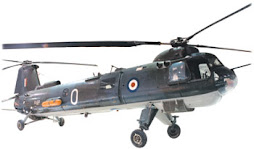
Hafner later worked for Bristol Aeroplane company (then based just over the road at Filton, Bristol, where I went to technical college) and designed Britain's first production helicopter, the Sycamore and then the twin rotored Belvedere. I have been a loyal BAC enthusiast ever since.
Bristol Sycamore (Hafner)
Bristol Belvedere (hafner)
Hafner Rotorbuggy (WW2)
Hafner Rotorchute (WW2)
bensen
hafner rotorchute (WW2)
One wartime design of Hafner's, the Rotachute, a means of dropping an infantryman into battle in a gliding autogyro was subsequently developed by Igor Bensen in the USA, one of which was bought by Wing Commander Ken Wallis (lovely bloke I interviewed for the dissertation), who massively developed it into a powered autogyro.. He built 19 of them in various guises, the most famous of which appeared in You Only Live Twice as Little Nellie, WA116. This short promotional filmcirca 1984 shows an intended production version.
Little Nellie
Beth and Tiger Moth, c1989
My sister, Beth, is not tubby, as the picture above suggests. She is slim and gorgeous - but here she is dwarfed by the flying kit she borrowed for a joyride in a Tiger Moth in Australia.
Dad in the Bristol University Air Squadron
The good looking young man on the right is my Dad in the late '50s, when he was flying Chipmunks with the Bristol University Air Squadron. I wonder what became of the boys looking out of the windows? Inset you can see him in the early 1960s, just before I was conceived in a powercut.
Dad? He went on to become a schoolmaster and took up gliding when he retired. I am very proud of him: In an air investigation report he was commended for his quick thinking as a novice pilot, after he brought a glider down safely when a fault led to the canopy blowing off.
Dad
manoevring your trike
Here is a nice trolley design with full maker's instructions.