Sunday, 1 June 2014

Quantum 15 / 582 For Sale

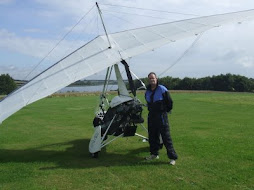
Now that I am heading over to the dark side, I am going to keep my new Pegasus Q as a cheap, fun flexwing and sell my more expensive Quantum to raise funds for a share in something fixed wing.

Bryan Smy has inspected, flown and permit-passed both the Q and the Quantum and he says both are great fliers, but if he could choose one, he'd have the Quantum, which he reckons has 6 years left in the wing. He said the pop it made as the Betts tester pricked the wing was a very good sign. I am delighted. He did some servicing on it, replaced the thingummies that the pylon slides between, sorted the brakes, renewed all the bungies which hold the ribs in (after a year out of flex flying, I cannot remember the names of things). I have re-organised the service history in the file so that everything is very accessible. I wish my house was that tidy!

Bryan put me on to someone who is looking for a Quantum, and he came and had a look. I was embarrassed by how dusty and muddy it was (no water at the airfield), so when he had gone, I used a large bottle of drinking water and some Fuchs-Off to spruce both my planes up.

I will get all the details together and do a proper advert, but for now if there is anyone who is interested, please email tinworm@hotmail.co.uk


I have just realised that I have had my Quantum exactly three years. Here's the blog entry

Sunday, 11 May 2014

finally getting back in the air


Had the pulmonary embolisms, the long period on Warfarin (now off it), the fortnightly blood tests, etc and now that I am fit, I am keen to get back in the air. I am waiting for my Medical Declaration to be signed by the GP, have renewed my lapsed BMAA membership and....

...have bought a second plane! It is a low hours Pegasus Q. I plan to permit it this week and possibly get the Quantum done too. Then I will sell the Quantum. I will get better economy with the Q, and because it is a cheaper, older aeroplane, I think I will feel I can justify having it, later in the year, when I hope to get a 3-axis aeroplane too.

And with the latter in mind I need to complete my interrupted fixed wing conversion. So, exciting times!

Thursday, 24 October 2013

Grounded

A couple of months ago I had pulmonary embolisms in both lungs, which almost killed me and which put me in hospital for a week. I was grounded, which meant not only that I couldn't fly my own plane (never, never call it a plane, Bader!) but also that I couldn't fly to Australia a few days later as planned. My trip was postponed by a month, and after that I spent a fantastic month visiting my sister in Melbourne, camel trecking and camping in the Outback and visiting friends in Darwin.

I am on warfarin now and making good progress. I can fly again, but now my aeroplane (it is an aeroplane, Bader!) is out of permit, so what I really must do in the next week or so is get down to the hangar and do some maintenance on her.

Thursday, 21 March 2013

small inputs

Small inputs
and give them time to take effect! 

I have now done my first unsupported landing in 3-axis. But I am very much over-correcting because I am used to a slower approach with a relatively rapid succession of large flexwing inputs. 

Can't wait to get up again this weekend (if weather allows) to practise my circuits, approaches and landings . . . 

and must make
 
small inputs
and give them time to take effect!


Saturday, 16 March 2013

Bernouille turned upside down

A year or two ago I saw a film on YouTube which appeared to debunk  the Bernouille Principle as a way of explaining the lift of a wing. Student pilots are always taught that an aeroplane flies because of the shape of a wing, which because of its shape experiences negative pressure over its top surface so that it is effectively sucked upwards (or forced upwards by the greater pressure beneath the wing). So this film said, how does that explain the fact that an aeroplane can fly equally well upside down?

I was fascinated and came away excited and confused. The film hadn't persuaded me that Bernouille was wrong, but on the other hand it obviously couldn't be the whole story.

I am reading a book called Stick and Rudder, which has apparently been continuously in print for the last 60 years and is very well regarded. The author, Wolfgang Langewiesche, says it is all due to the angle of attack, and that while Bernouille is no doubt true, it obscures the whole business: 

   "Trying to understand the piloting of airplanes by concentrating on Bernouille 
and Prantl is like trying to catch on to tennis by studying just exactly 
how the rubber molecules behave in a tennis ball"

I have only just started the book, but essentially he says that all flight is about the angle of attack of an inclined plane (surface). So that is why my hand, which is not aerofoil sectioned, rises when I stick it out the car window, or why an aerobatic aeroplane with almost no hump in its wing flies equally well upside down!


Friday, 15 March 2013

Stick and rudder


Talking about adverse yaw with Mike, yesterday, I was made to realise that I only half understood what causes adverse yaw in a turn. I have been reading what is now a very old flying manual, as it was written for RAFVR pilots at the start of the war (but on the premise that aerodynamics do not change). Perhaps their description was too simplistic, or perhaps I misunderstood it. But blurting out that I understood this, then going on to mis-describe it in earshot of other pilots was humbling.

I said that adverse yaw was created when the outside wing, travelling faster than the inside one, suffered induced drag, so pulled back in the opposite direction to the turn. Mike said that actually you get more induced drag when the wing is going slower.

Mike explained that yaw is not a component of speed but of lift, and now it is slowly becoming clear in my mind, a day later! I am devising a teacher’s way of explaining it to myself and possibly others (about which, more later).

It needs to be reiterated that any misunderstanding is my own, not Mike’s, obviously. And also, if I have not got it right since Mike explained it, that isn’t a fault of his explanation, but my slowness in getting something. I have always been like this. I need to go away and think things through, which is what I am doing now. And remember, this is not a manual I am writing here, it is me playing with what I am learning, and trying to get some sense out of it.

By patient Q&A, Mike eventually drew the words “angle of attack” out of me and then went on to show me the effects on the chord line (leading edge to tip of the aileron) of depressing the aileron. The increased angle of attack increases that wing’s lift, and it is the increased lift, not the speed, which creates the drag. On the opposite wing, the raising of the aileron (raising the rear of the chord line so that it is pointing down) reduces the angle of attack and therefore reduces its lift, so there is less induced drag on that wing.

Visually (as well as technically), there is another aspect to this, which is the direction of the lift (it is all flooding back to me now, but I must revise all this, as it has been 5 years since I did my Principles of Flight exam). Lift is perpendicular to the relative airflow.* So, the outside wing’s lift is pointing backwards, while the inside wing’s lift is pointing forwards and if I am right, it is that, too, which causes the direction of yaw.  I think what we are saying is that because the lift is pointing backwards lift drags that wing backwards; drag is the secondary effect of lift.

So that is where my original misunderstanding came in. I said that airspeed created drag. Actually, greater airspeed creates lift and it is the lift which creates drag. Here’s a thought, maybe it would be more helpful to talk in terms of directions of forces. If the force perpendicular to the relative airflow is upwards and backwards, it will try to pull the wing (and the aircraft to which the wing is attached) upwards and backwards towards that wingtip. And because you want to turn in the opposite direction, you need something to counter this force, which is where the rudder comes in.

I am getting used to pushing the stick and rudder in the same direction (stick right, right rudder pedal) and that doesn’t pose a great problem, conceptually, except on the ground, taxying - where this is opposite to a flexwing's steering). I have been getting used to using the clinometer (turn and slip indicator), which is a curved glass tube spirit level with a ball sitting at the bottom in the middle. In a turn, you have to use the rudder to keep the ball in the middle to achieve a balanced turn, where the aeroplane is not tending to skid outwards of the turn or slip inwards of it. When the ball rolls to the left, you have to apply left rudder to correct this and bring it into balance again. I was pleased that I got the hang of this.

(My copy of Stick and Rudder, by Wolfgang Langewiesche - recommended by Katie - just arrived. Am off to do some reading now) 

* Mike just rang to say that people in the clubhouse have just been discussing what I wrote and he asked me to explain what I meant by saying that lift was perpendicular to angle of attack. Oh dear! I got that bit wrong. I have changed it to perpendicular to the relative airflow. "I will leave you to ponder that one", he said.
:)

A friend of mine who was on the same Masters programme as me at Imperial College, and who is very scientific, and was in fact a curator at the Science Museum said, after reading this, "Blimey, and I thought riding a bike was difficult!"

Friday, 8 March 2013

Our pathetic flying documents

With my licence revalidation due soon, I had an almighty search for my medical certificate yesterday. Took me two hours to find it. I was looking for the old style pink card, forgetting that the current one is an online download. I don't know how it slipped out of my licence's wallet, but because it is now just a flimsy bit of A4 it ended up with a load of receipts in a paperwork tray. 

What a relief to find it. But it does highlight for me how flimsy our paperwork is. Just look at our pilot's licences. After all our hard work, you'd expect a document that really looked the part....something like an old fashioned, crested passport would be about right!

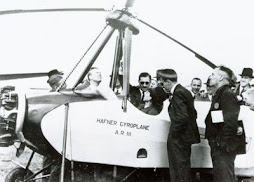
When I researched my dissertation on Raoul Hafner, looking through his private papers I found his autogyro licence, issued in 1933 and it was hard bound with fine scrollwork: Federation Aeronautique Internationale British Empire....lots of fine writing both in English and French, with personal details and on the page opposite, Hafner's photo and large, proud signature. It was a worthy document, unlike the pathetic thing we carry - and are forever in danger of losing.